
How Many Steps in a Mile? Exact Answer, Formula, Chart & Step Conversion Guide
Did you know that the number of steps in a mile can vary from person to person? Understanding how many steps are in a mile is not just a fun fact; it’s essential for anyone looking to track their fitness or set walking goals. Whether you’re an avid walker or starting your fitness journey, knowing your stride length is essential to achieving your goals.
This article will clarify “how many steps in a mile”. You’ll discover the exact answer, a useful formula, factors affecting these numbers, and detailed charts, along with a step-by-step conversion guide to measure distance.
How Many Steps in a Mile?
When you think about walking a mile, the number of steps it takes can vary. On average, people take between 2,000 and 2,500 steps to cover that distance. A good rule of thumb is 2,200 steps per mile. Taller individuals generally have longer strides and may take fewer steps, while shorter individuals may need more steps. There’s also a difference between running and walking. Runners tend to take fewer steps per mile because they cover more ground with each stride. Fitness trackers often use the 2,000 steps per mile.

How Many Steps Are in a Mile Based on Height?
| Height | Approx. Steps per Mile |
| 5’0″ | 2,500–2,600 |
| 5′4″ | 2,300–2,400 |
| 5’8″ | 2,100–2,300 |
| 6’0″ | 1,900–2,100 |
Step-to-Mile Conversion Formula
The formula to convert steps into miles is: take the number of steps and divide by approximately 2,200. This gives you a rough estimate. The average person has a stride length of 2.1 to 2.5 feet, so one step isn’t the same distance for everyone. Using someone’s actual stride length provides a more accurate measurement.
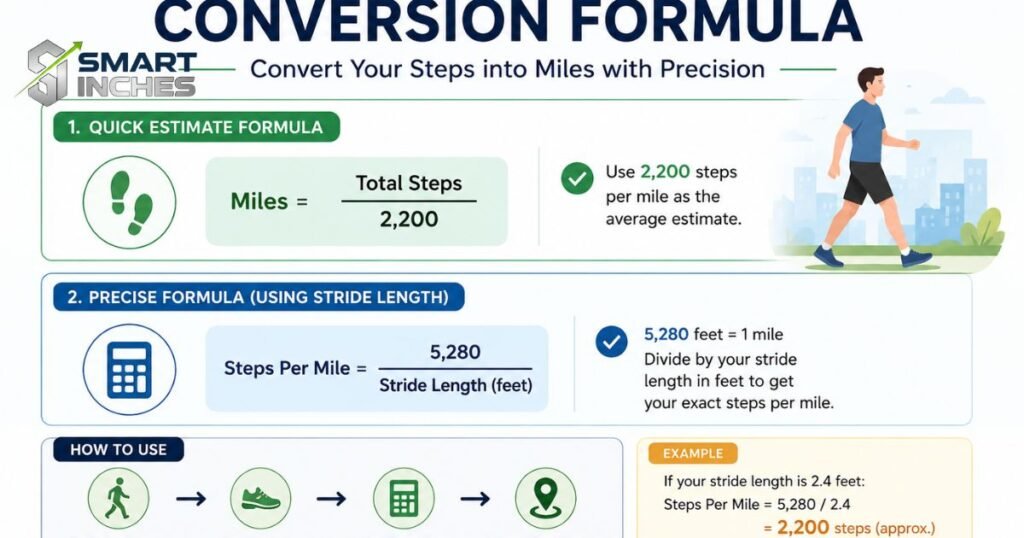
For precision, measure your stride length by walking a known distance and counting your steps. Use this calculation: Steps per mile = 5,280 ÷ Stride Length (feet). This method accounts for individual differences and gives you a clearer picture of how many steps equal a mile for you.
Steps in 1 Mile Based on Stride Length
Your stride length affects how many steps you take per mile. If you have a short stride, around 2.0 feet, you might take approximately 2,600 to 2,700 steps to cover that distance. This can often happen if you’re walking quickly or if you’re on the shorter side. With an average stride of about 2.2 feet, you’ll typically take around 2,300 to 2,400 steps. For longer strides, approximately 2.5 feet, the count drops to about 2,100 to 2,200 steps per mile.
| Stride Length | Approx. Steps per Mile |
| 2.0 ft | 2,640 |
| 2.2 ft | 2,400 |
| 2.4 ft | 2,200 |
| 2.5 ft | 2,112 |
| 2.6 ft | 2,030 |
Steps in Miles Conversion Chart
When converting steps to miles, having a clear conversion chart can be helpful. For an easy reference, you can use a conversion formula. Multiply your step count by your stride length, then divide by 5,280 (the number of feet in a mile).
| Miles | Steps (Approx.) |
| 0.5 mile | 1,100 steps |
| 1 mile | 2,200 steps |
| 2 miles | 4,400 steps |
| 3 miles | 6,600 steps |
| 5 miles | 11,000 steps |
| 10 miles | 22,000 steps |
How to Calculate Exact Steps Per Mile?
To calculate your exact steps per mile, choose a known distance, ideally 1 mile or 1 kilometer. As you walk this distance, use a pedometer or smartwatch to track your total steps. Once you finish, record the number of steps you’ve taken for that specific distance. Next, use this formula: Steps per mile = Total steps ÷ Miles walked. It’s best to repeat this process 2 to 3 times to ensure accuracy. Maintain a consistent walking speed during each measurement for reliable results. Finally, take the average of your trials to get a more precise value.
This method allows you to personalize your step tracking. Instead of relying on generic estimates, you gain a clear understanding of your stride.
Factors That Affect Steps Per Mile
Several factors influence how many steps you take in a mile.
- Step Consistency: Different walking styles can affect stride length.
- Footwear Type: The shoes worn can also impact stride comfort. Proper footwear can enhance stride length and efficiency, while uncomfortable shoes can lead to shorter, choppy steps.
- Height of Person: Taller individuals usually have longer strides and take fewer steps per mile. Shorter people generally take more steps due to their smaller stride lengths.
- Walking Speed: The speed at which you walk affects how many steps you take. Walking slowly typically leads to more steps over a mile, while brisk walking reduces the total step count.
- Running vs. Walking Style: Running involves longer strides compared to walking. Runners cover more ground with each step.
- Terrain: The type of terrain can impact your steps. Walking uphill requires shorter, more frequent steps, whereas flat surfaces allow for longer strides.
- Stride Length Variation: Your average stride length influences your steps. Over time, individuals may develop a preferred stride length, which can vary based on pace and terrain.
- Fitness Level and Body Mechanics: Healthy, fit individuals often have a more efficient gait. Body mechanics, such as posture and leg movement, also play a vital role in your overall step count.
How Many Steps Are in a Mile at Different Speeds?
| Speed | Steps per Mile |
| Slow walk | 2,500 |
| Normal walk | 2,200 |
| Brisk walk | 2,000 |
| Running | 1,500–1,800 |
Walking vs Running Steps Per Mile
When it comes to walking versus running, the number of steps you take per mile varies. Generally, walking requires about 2,000 to 2,500 steps to cover a mile, while running takes around 1,400 to 1,800 steps.
How Many Walking Steps in a Mile?
Walking a mile typically requires about 2,000 to 2,500 steps. The average estimate is around 2,200 steps. The variation depends on personal factors like your stride length and walking speed.
How Many Steps in 1 Mile for a Woman?
The average woman takes between 2,200 and 2,600 steps to walk a mile. This range is primarily due to shorter stride lengths compared to men. So, if you’re tracking your steps, you notice that you hit a higher count for the same distance.
How Many Steps in 1 Mile for a Man?
On average, a man takes between 1,900 and 2,300 steps to cover one mile. This range is due to men generally having a longer stride length. With longer strides, men tend to need fewer steps to complete a mile than women.
Real-Life Uses of Step-to-Mile Conversion
Step-to-mile conversion is very useful for practical life. The following are the most common real-life uses of this conversion.
- Daily Fitness Tracking: Smartwatches and pedometers count steps and convert them to miles. This helps users see how much they’ve moved each day.
- Setting Walking Goals: Many people use step counts to set daily goals, such as the popular 10,000 steps challenge. Achieving this can boost motivation and encourage consistent movement.
- Weight Loss and Calorie Burn: Converting steps to miles can help estimate calories burned during workouts. This data can guide diet choices and fitness plans.
- Running and Marathon Training: Runners can plan their training distances by converting step counts into miles. This ensures they stay on track for race day.
- Health Monitoring: Fitness apps often track steps and convert them to distance. This feature helps users monitor their progress over time.
- Activity Tracking in Workplace Wellness: Companies use step-to-mile conversion to encourage employees. Teams can compete in challenges based on the distance covered.
- Measuring Distance Without GPS: For those in areas without GPS, converting steps to miles gives an accurate distance measure. It’s a simple solution for anyone wanting to stay active.
Common Mistakes to Avoid
When converting steps to miles, many fall into common traps that skew their results. One mistake is assuming that everyone has the same number of steps per mile. In reality, each person’s stride length varies. Ignoring these differences can lead to inaccurate estimations.
Another error is mixing walking steps with running steps. These activities have different impacts and therefore should be measured separately. Using an incorrect average, whether too high or too low, can distort your distance calculations. Proper calibration of fitness trackers is essential.
It’s also essential not to count steps without considering the actual distance traveled. Terrain matters too. Walking on a flat surface versus uphill can change your step count. Relying on guesswork instead of using a proven formula or real test data can mislead your fitness goals.
Conclusion
Understanding “how many steps is 1 miles” is useful in everyday life. On average, there are about 2,000 to 2,500 steps in a mile, but this number can change based on your individual stride length. By using the given formulas and charts, you can easily convert your steps to miles. This knowledge also helps track your fitness and health goals. Whether you’re walking for fitness or fun, knowing your step count can keep you motivated. So, lace up your shoes and start counting those steps!
FAQs
How Many Steps is a Mile?
The average number of steps per mile is between 2,000 and 2,500 steps. Many people use the estimate of about 2,200 steps as a standard reference.
How Many Feet in a Mile?
A mile is equal to 5,280 feet. This measurement is part of the U.S. customary system, which is commonly used in everyday situations like road signs and maps.
How Many Walking Steps are in a Mile?
On average, the number of walking steps in a mile falls between 2,000 and 2,500 steps. Most people take about 2,200 steps to walk a mile at a normal pace. This range depends on factors like your stride length and height.
How Many Miles is 10000 Steps?
Walking 10,000 steps is a popular fitness goal. On average, this is about 4.5 to 5 miles. The exact distance can vary due to your stride length.